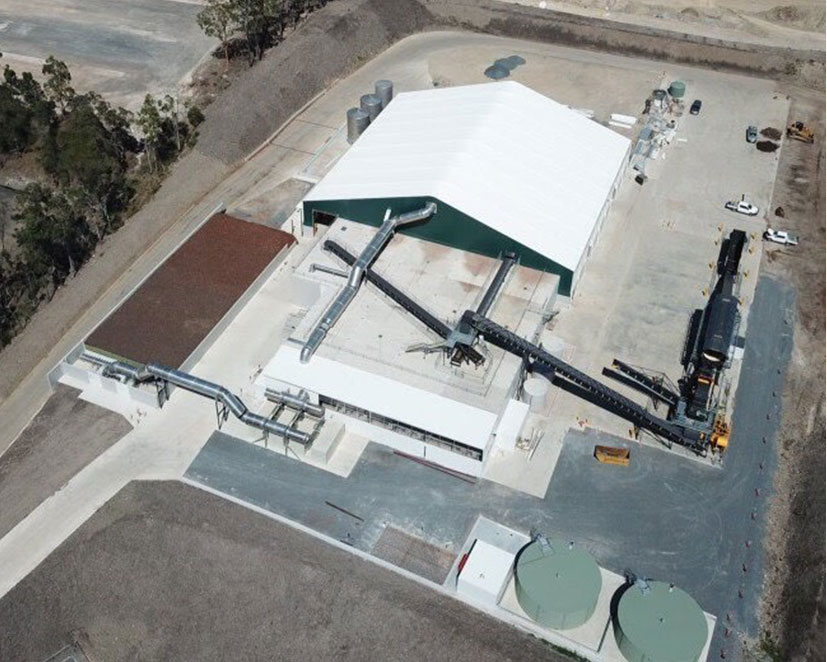
Phoenix Power Recyclers is among Australia’s leading organics recycling companies.
Phoenix Power currently manufactures in excess of 50,000 cubic meters of finished compost per annum. Their signature ‘Prescription Compost 100’ is used to make landscaping soils, soil conditioners and other growing media for agricultural and horticultural applications through premium soil-conditioning distributors.
Located in the continually growing Yatala Industrial Precinct within the Gold Coast region, the Sandy Creek Rd site is a comprehensive organics recycling facility predominantly handling food & green solid and liquid organics waste. In addition to organics, Phoenix produces biomass fuel from shredded timber products and oversize green waste.
Phoenix Power has approvals centred around developing an Eco-Cluster concept. At present the principle focus is the processing of food and garden waste (FOGO) to produce compost for direct sale or for onsite blending with top soils and other amendments.
Phoenix uses ‘Best Practice’ in-vessel composting technology imported from Netherlands that accelerates the initial phase of composting called ‘pasteurisation’. To utilise this technology all of the product accepted is blended with liquid and placed into purpose built concrete tunnels some 1250m3 in size, each ultimately holding approx. 500 tonnes of food & green waste along with a further 150 tonne of liquid waste.
The receival of all nuisance odour wastes can now be achieved in a negative pressure environment where trucks are able to discharge solid waste indoors. Liquids are decanted directly into site tanks.